
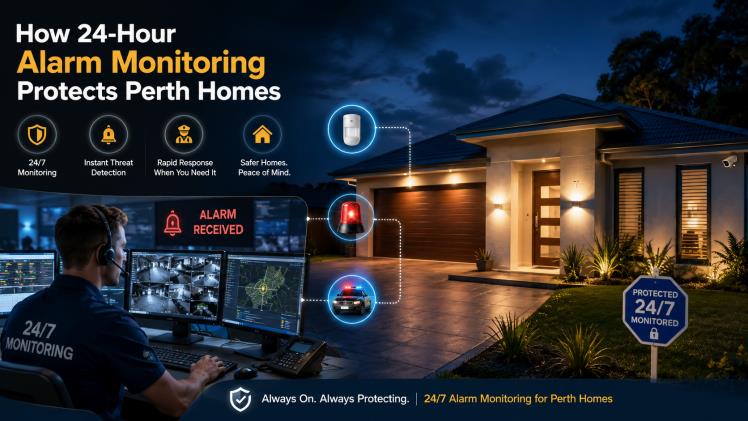
 A home alarm that only makes noise is doing half its job. Once the shock of a triggered siren wears off, most burglars are gone within minutes, long before anyone has worked out what actually happened. That gap is exactly where round-the-clock monitoring earns its keep for Perth households.
Why an unmonitored alarm falls short
A standalone siren relies entirely on someone nearby noticing and acting. In quieter suburban streets, or when a family is away on holiday, that simply does not happen reliably enough. Neighbours grow used to the odd false alarm and stop paying attention altogether.
This is the gap that a proper alarm monitoring Perth closes, because a trained operator is watching the signal the moment it fires, not waiting for a passerby to notice.
Rather than hoping someone reacts, a monitored system routes every trigger straight to a control room. That single change turns a passive deterrent into an active response system, which matters most in the early minutes of a break-in when speed genuinely counts.
Even well-meaning neighbours cannot watch a property around the clock, and most people simply are not home during the working week. A monitored connection removes that dependence on luck and replaces it with a consistent, trained response every single time.
How the monitoring process actually works
When a sensor trips, the signal travels to a monitoring centre within seconds. An operator checks the details of the alert against the property profile before deciding on the next step, filtering out obvious false triggers such as a pet or a loose window.
If the alert looks genuine, the operator attempts to contact the household directly using an agreed passcode system. This confirms whether it is a real emergency or an accidental trip, and prevents unnecessary callouts that waste everyone’s time and erode trust in the system.
Should there be no answer, or the wrong passcode is given, the operator escalates the alert to the appropriate authorities and notifies emergency contacts. The whole sequence, from trigger to dispatch, typically takes well under a minute once verification is complete.
What this means during an actual break-in
Intruders rarely linger once they suspect a property is monitored, and visible signage alone can be enough to change their mind. Knowing that a response is already underway, rather than dependent on luck, changes the entire risk calculation for anyone targeting a home.
For families who travel often or work irregular hours, this constant coverage matters even more. A monitored system does not take days off, and it does not forget to check the back gate, which gives genuine reassurance when nobody is home to keep watch.
Choosing a monitoring provider that fits your home
Not every provider offers the same response standards, so it pays to ask how alerts are verified and how quickly a typical dispatch happens. A good installer will walk through this process clearly rather than leaving it vague in the sales pitch.
Life outside the alarm panel matters too, and plenty of Perth locals like to unwind after a long day in something comfortable, whether that is browsing modern graphic tees online or just relaxing at home knowing the property is covered.
It is also worth checking whether the system integrates with a smartphone app, since being able to arm, disarm, or check status remotely adds a layer of convenience on top of the core monitoring service most households now expect as standard.
Common questions Perth homeowners ask
One frequent concern is cost, and while monitored plans do involve an ongoing fee, most households find the monthly amount modest compared with the potential loss from an unaddressed break-in or the excess on a home insurance claim.
Another common question is contract length. Some providers lock customers into lengthy agreements, while others offer more flexible month-to-month terms. Reading the fine print before signing avoids any unpleasant surprises further down the track once the system is installed.
Compatibility with an existing setup also comes up often, particularly for older homes with wired systems already in place. A reputable installer will assess what can be reused and what genuinely needs upgrading rather than pushing a full replacement unnecessarily.
Finally, many homeowners ask about false alarm rates, since a system that triggers too often quickly becomes background noise. Modern sensors with better calibration have reduced this significantly, and most providers can fine-tune sensitivity during installation to suit each property.
Some households also want to know whether pets set off motion sensors unnecessarily. Pet-friendly sensors are now common, and a good installer will factor this in during the initial walkthrough so the system does not trigger every time the cat wanders past.
Making the decision
Choosing round-the-clock monitoring is less about adding another gadget and more about closing the gap between a triggered alarm and an actual response. For Perth homes, where properties can sit unattended for hours during work and school days, that gap is worth taking seriously.
Talking to a local provider about coverage, response times, and system compatibility is the simplest way to work out what level of monitoring suits a particular household, rather than assuming one standard package fits every home in every suburb.
In the end, the value of monitoring is measured not in the alarms that never sound but in the ones that do, and how quickly a genuine response follows. That is the reassurance most Perth families are really paying for.
Homeowners renovating or extending a property is also a good moment to reassess coverage, since new rooms, doors, or entry points can leave gaps in an older system if the plan is not updated alongside the build itself.
Ultimately, the goal is simple: a quiet, uneventful year is the best possible outcome, and round-the-clock monitoring is what quietly makes that outcome far more likely for households across the greater Perth area, from the coast to the hills.
For anyone still weighing up whether monitoring is worth the ongoing cost, it helps to think of it less as an expense and more as a standing, trained response team who happen to be watching a specific property every hour of every day.


